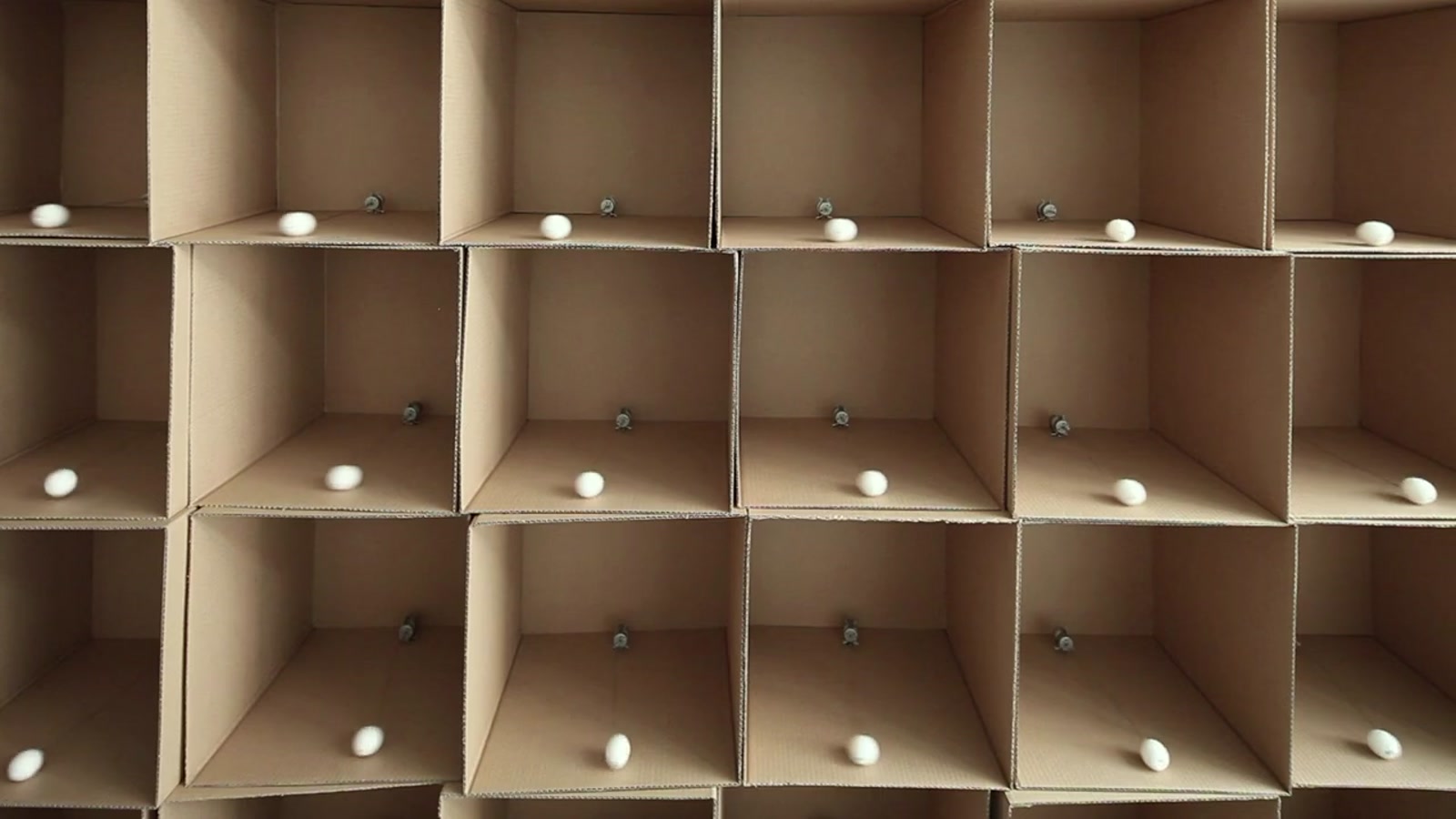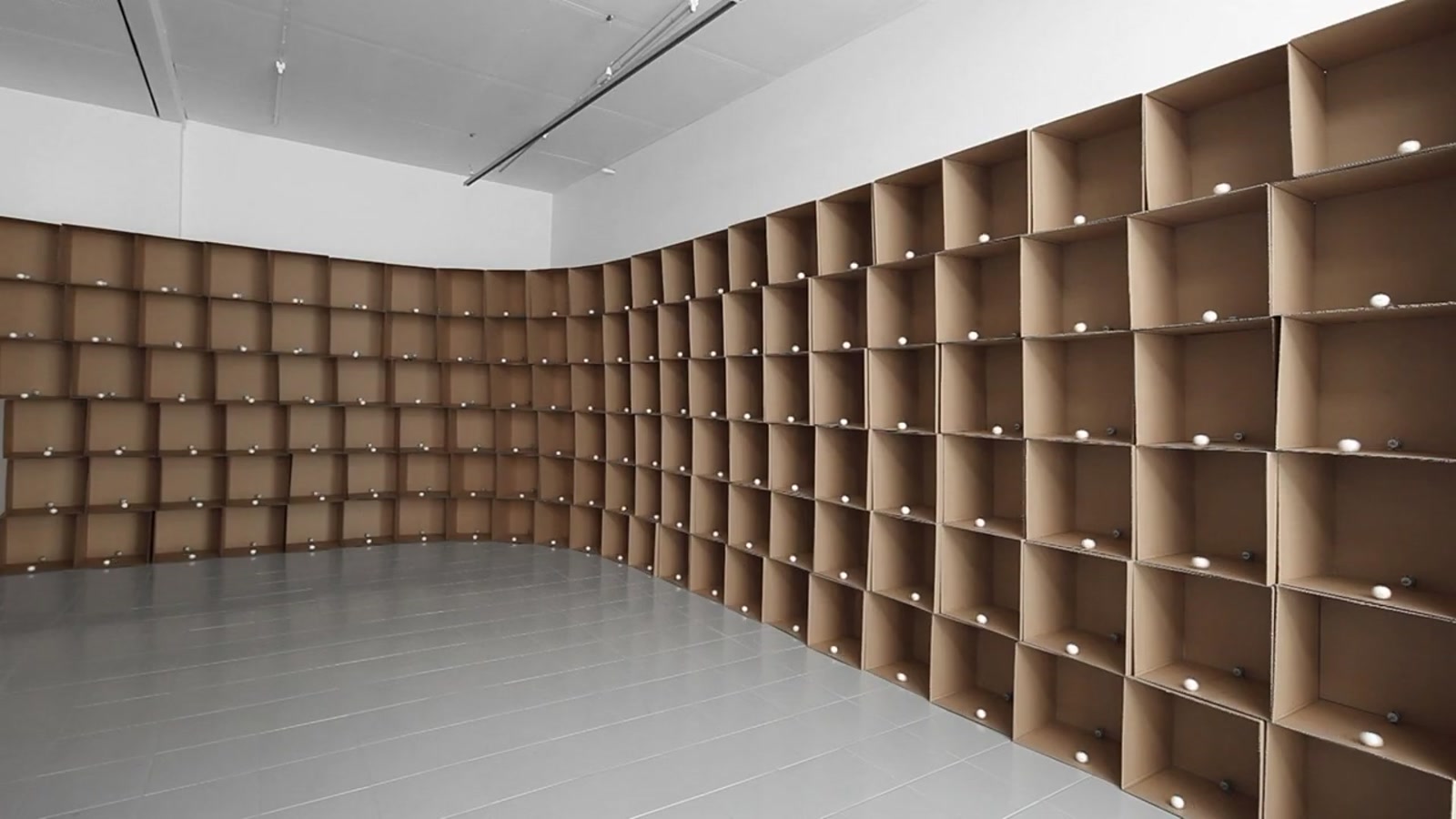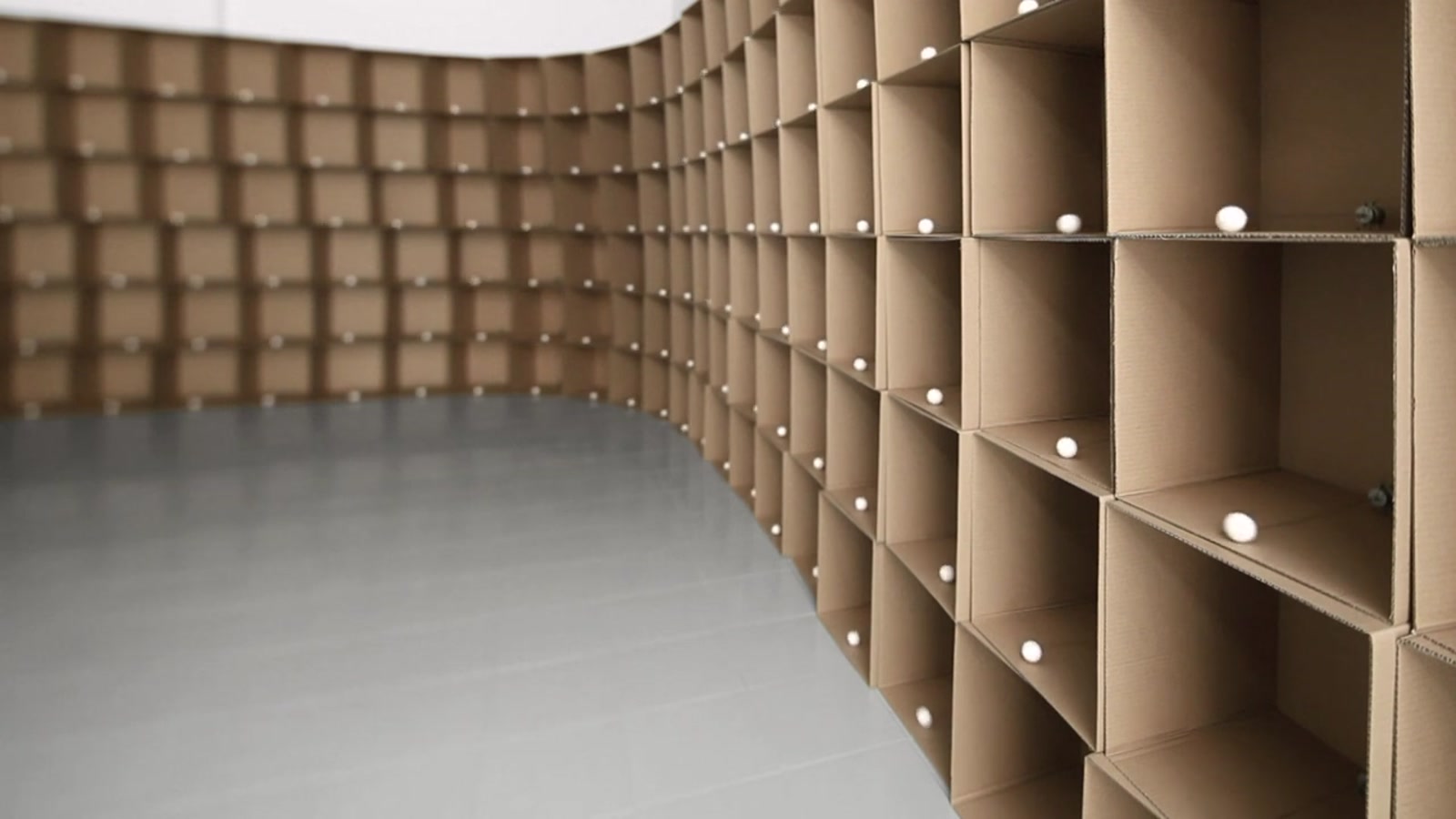
A white cotton ball moves against brown cardboard. Repeat that small event across a wall and the familiar packing material becomes the structure of an instrument. Zimoun’s 2011 installation at Lydgalleriet in Bergen turns a simple mechanical action into a dense, changing field.
The work’s descriptive title lists its ingredients: 138 prepared dc-motors, cotton balls, cardboard boxes 40x40x40cm. The artist’s documentation adds filler wires and a power supply to that inventory. Its materials are easy to recognise, which makes it possible to follow an individual moving element before taking in the larger arrangement.
A pattern built from differences
Lydgalleriet places the installation within a series informed by Karl Popper’s distinction between the regularity of clocks and the irregularity of clouds. The gallery describes Zimoun’s use of small mechanical movements and slight differences between individual units to build complex soundscapes.
That relationship is the reason to linger. An ordered grid gives the work a clear framework, while the activity within it keeps pulling attention from one point to another. The repeat is legible; the combined result keeps changing.
Cardboard also makes the action readable. It functions as both the visual field around each moving ball and a material that participates in the sound. The work invites the eye to trace the same event that produces the installation’s acoustic texture.
An installation from 2011
This is a discovery from Zimoun’s archive. The footage documents the 2011 Lydgalleriet installation, curated by Jørgen Larsson, rather than a newly announced exhibition. The artist credits Jacob Alrø, Tolga Balci, Vanessa Gageos and Florian Bürki for assistance.
The appeal lies in how much emerges from so little: a motor, a wire, a soft ball and an everyday box, repeated until the room starts to feel active.
People & sources
Artwork and original documentation: Zimoun. Installation view: Lydgalleriet, Bergen, Norway, 2011; curated by Jørgen Larsson. Assisted by Jacob Alrø, Tolga Balci, Vanessa Gageos and Florian Bürki. Original English narration and editorial: HurolHaber.
A closer look