
Art
Felix Semper’s Paper Sculptures Stretch Like Accordions
Thousands of glued paper layers let a familiar sculpted form expand, bend and return to its compact shape.

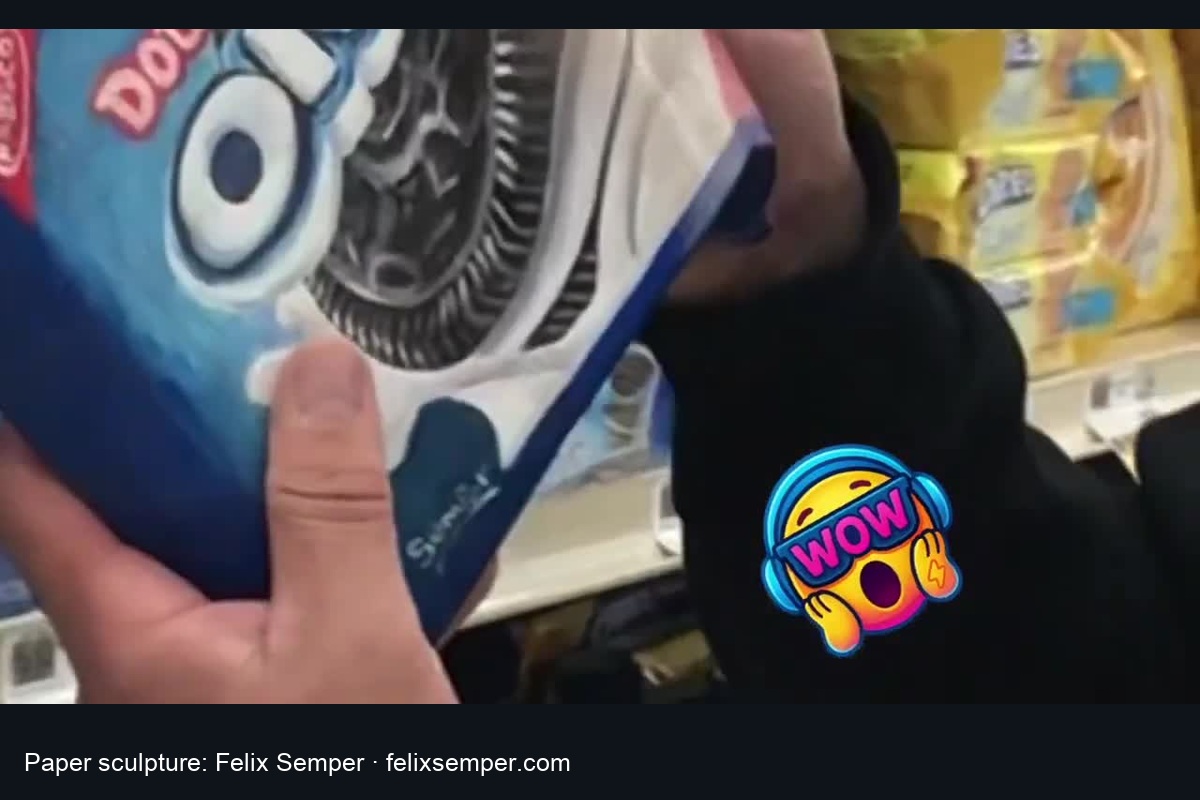
A sculpted form is lifted and drawn apart, revealing a long sequence of paper folds. Felix Semper’s flexible sculptures make their construction visible through movement: the compact image opens into layers, then comes together again.
On his official site, Semper describes a practice built around thousands of individually stacked and glued sheets of paper. Cutting and shaping the assembled layers produces recognizable figures and objects while retaining the flexibility of the paper construction. This is an introduction to that continuing practice; no release date is being assigned to an unidentified work.
What makes the demonstration so effective is how quickly our reading of the object changes. First we recognize the sculpted subject. Then we start following the expanding layers and noticing the work as a structure made from repeated pieces.
The material is doing more than providing a surface for an image. Its movement becomes something to watch in its own right. For anyone interested in making, these sculptures offer a memorable reason to look again at an ordinary sheet of paper and imagine what repetition could allow it to do.
Creator and source credits: Artwork and source visuals: Felix Semper. Original narration and editorial: HurolHaber.
Sources: Felix Semper — official artist website · Felix Semper — About
Featured demonstration: Felix Semper’s original paper-sculpture video, published 18 July 2025.
Also watch on HurolHaber: YouTube Shorts · Instagram Reel.

Art
John Edmark’s Spinning Sculptures Seem to Bloom
A rigid 3D-printed shape appears to grow and unfold when its rotation meets carefully timed images.
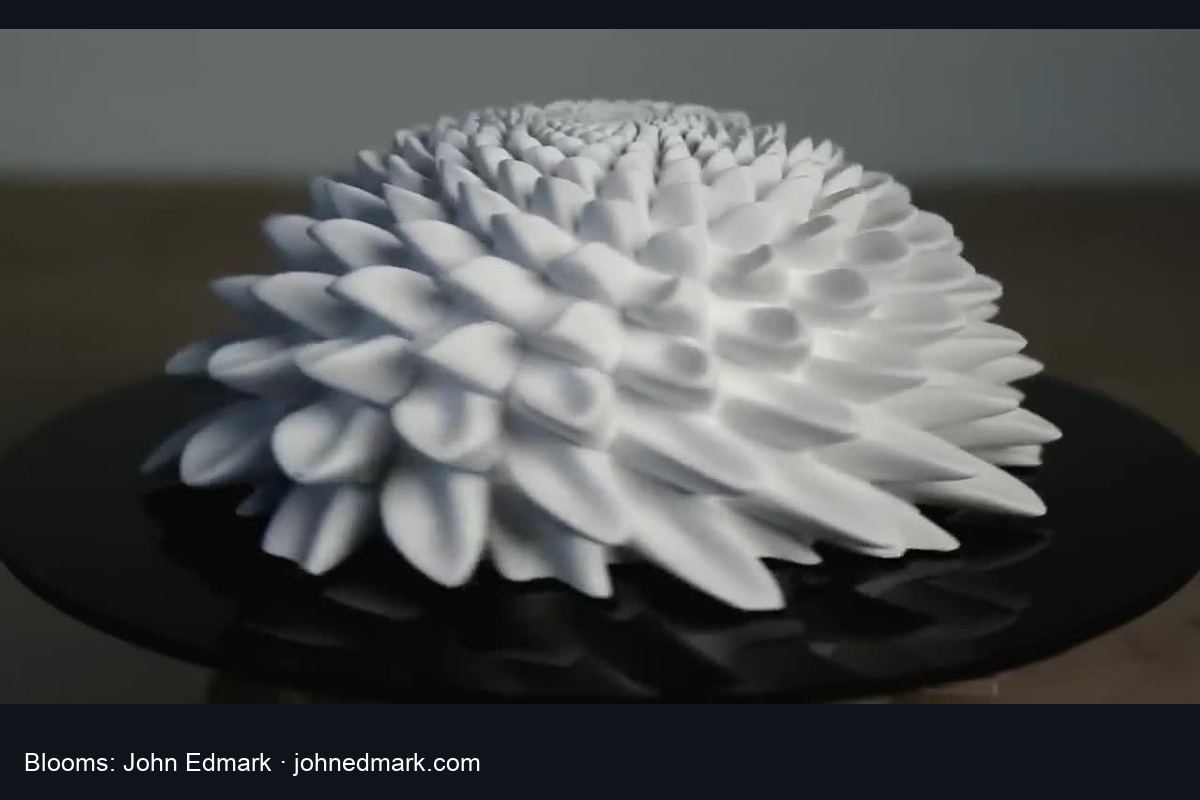
A white shape spins, and its surface appears to climb, open and grow. John Edmark’s Blooms make a physical sculpture behave like an animation through the timing of what we see. The original video dates to 2015; this is a design discovery from the archive.
Edmark describes the works as single, self-contained 3D prints. Their forms use the golden angle, approximately 137.5 degrees. For a strobe-lit demonstration, rotation and flashes are synchronized so that a flash follows each turn through that angle. The video featured on his site uses a short camera exposure instead.
The fascinating thing to watch is the relationship between the individual shape and the sequence of views. A surface that looks still in a photograph develops a completely different character when sampled in motion.
It is an inviting meeting point between sculpture, mathematics and filmmaking. Save a still image, then return to the moving version: the contrast shows how much the act of looking contributes to the work.
Creator and source credits: Sculpture and source imagery: John Edmark / Blooms. Original narration and editorial: HurolHaber.
Sources: John Edmark — Golden Angle / Blooms · Blooms — original artist video
Watch the original artist video
Also watch on HurolHaber: YouTube Shorts · Instagram Reel.
Art
Thomas Deininger’s Birds Hide in a Tangle of Discarded Objects
A bird from one viewpoint, a collection of familiar objects from another: Thomas Deininger makes the act of looking part of the sculpture.
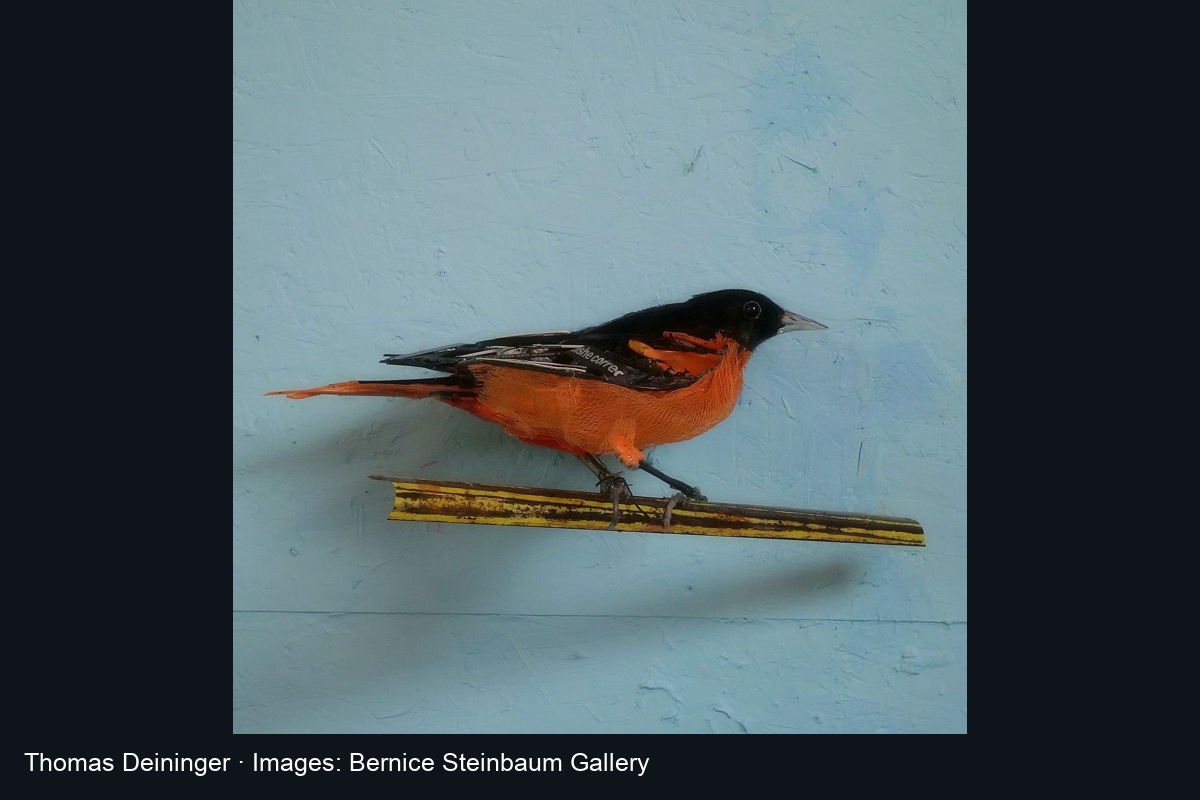
The first image is a bird. Shift your viewpoint, and the materials start to take over: toys, everyday objects and fragments, arranged in space rather than smoothed into a conventional animal sculpture. Thomas Deininger makes recognition depend on where we stand.
In his artist statement, published by Bernice Steinbaum Gallery, Deininger identifies perspective, illusion and disposable consumer culture among the recurring concerns of his found-object work. His studio’s recent-work gallery includes birds dated 2024 and 2025, from a macaw to a hummingbird. This is an introduction to that continuing practice, rather than a newly announced project.
For us, the interesting moment comes when the animal stops holding together. The side view is part of the work’s meaning: the apparently unified creature shares its space with a collection of things that once had other uses. An ordinary toy can become a patch of colour or an edge, while keeping enough of its old identity to be recognised again.
That makes these sculptures particularly rewarding to revisit. Start with the bird, then look for the objects, then try to find the bird again. The work turns a quick visual surprise into a small exercise in questioning a first impression.
Creator and source credits: Artwork: Thomas Deininger. Images: Oriole and Oriole (detail), via Bernice Steinbaum Gallery. Artist statement: Thomas Deininger / Bernice Steinbaum Gallery.
Sources: Thomas Deininger Studios — Recent Work · Thomas Deininger — artist statement at Bernice Steinbaum Gallery
Also watch on HurolHaber: YouTube Shorts · Instagram Reel.


HygroShape Lets Flat-Packed Wood Find Its Furniture Form

Ora Ïto Gives the Renault 17 a New Shape for an Electric Show Car

Felix Semper’s Paper Sculptures Stretch Like Accordions

In Viewfinder, a Photograph Can Become the Path Ahead

John Edmark’s Spinning Sculptures Seem to Bloom




-

 Games9 years ago
Dolar 3,79TL • Euro 4.70TL • Bitcoin 42.179TL olmuş
-
 Art9 years ago
Mina Başaran ve arkadaşları uçak kazasında ölmüş
-

 Games2 years ago
States Builder: Trade Empire
-

 Design9 years ago
Romanyalı adam yaşadığını mahkemeye ispat edemiyormuş.
-

 Cars9 years ago
Mark Zuckerberg, Cambridge Analytica olayında hatalı olduklarını kabul etmiş.
-

 Entertainment5 years ago
The Mitchells vs the Machines
-

 Cars9 years ago
Challenger uzay mekiğini Nakşibendi’ler düşürmüş
-

 Art9 years ago
İstanbul’da sis bugün de devam edecekmiş