
Woodworking
Flow Wall Desk Turns a Wooden Wall Panel into a Place to Work
Robert van Embricqs turns a slatted wooden wall panel into an unfolding desk, making the transformation part of the design.

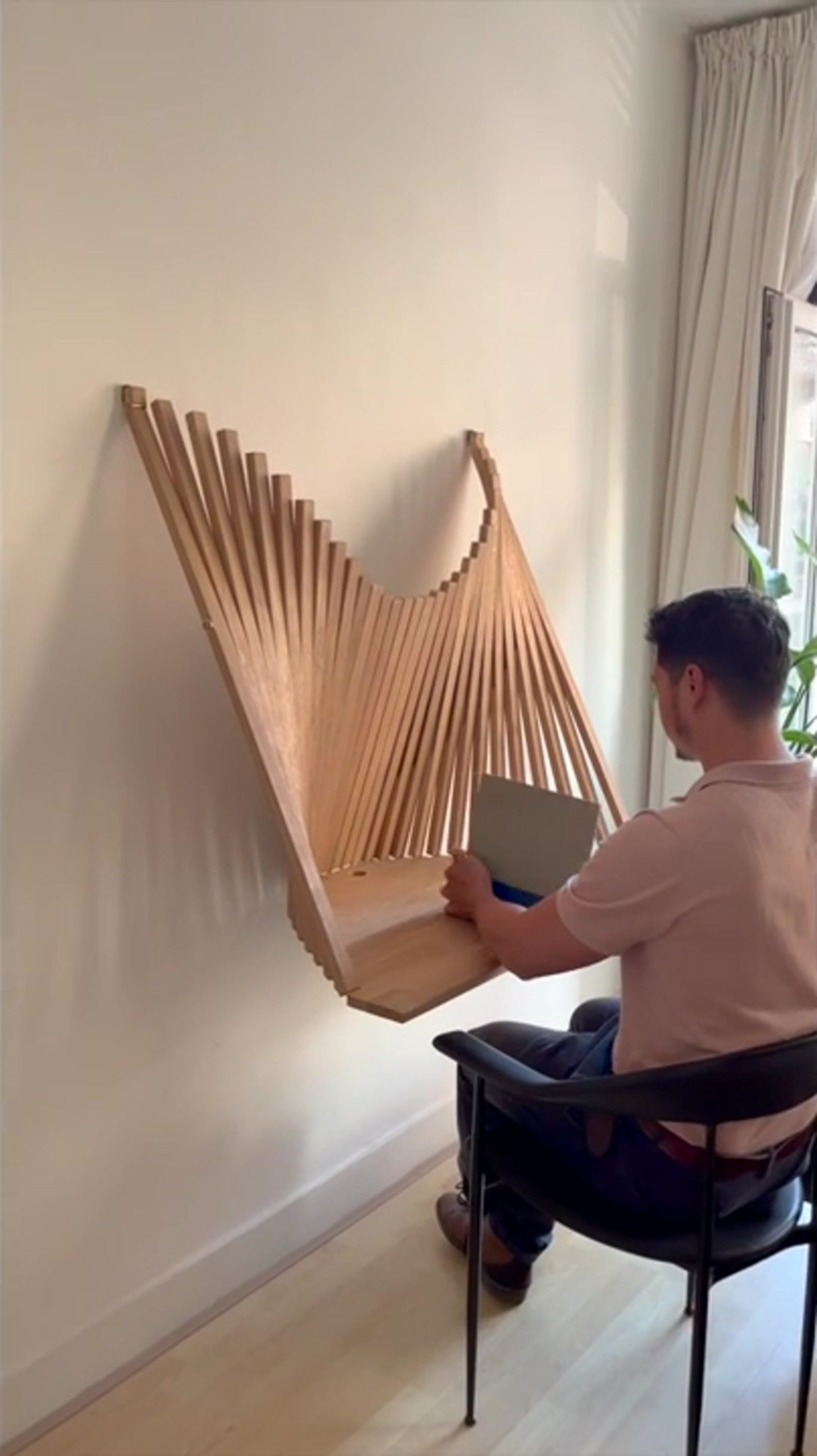
The wall appears to be wearing a neat wooden panel. Its slats form an orderly surface, with very little to suggest that anything is waiting behind it. Then the middle begins to move. The strips rotate out of alignment, the panel opens into a shallow fan, and a horizontal surface arrives exactly where a desk should be.
This is the Flow Wall Desk by Dutch designer Robert van Embricqs. The designer's own transformation videos date to December 2022, so this is an archive discovery rather than a newly announced product. His project page explains the movement through custom brass hinges and wooden slats that become both structural support and a partial screen around the workspace.
What makes the desk compelling is how openly it performs its change. Many folding objects try to hide a conventional piece of furniture inside a smaller box. Here, the same repeated elements remain legible in both states. The wooden pattern on the wall becomes the rhythm of the opened desk. Watching it unfold is also a way of understanding it.
The designer’s own transformation film makes that choreography easy to follow: hands pull the panel forward, the slats leave the wall, and the central surface settles into place. The sequence then shows the opened desk being used, turning a clever change of shape into a place to sit and work.
A folding desk offers a practical answer to limited space. This one also gives the room a small ritual. Work begins with a physical gesture and ends when that gesture is reversed. Even when nobody is sitting there, the closed object still has a reason to occupy the wall.
Archive discovery · Creator video published December 2022.
Design and original transformation footage: Robert van Embricqs. Original English reporting and narration: HurolHaber.
Sources

Woodworking
Fletcher’s Capstan Table Opens into a Bigger Circle
Fletcher’s Capstan Table stores its expansion leaves inside itself, opening into a larger round tabletop. A look at the maker’s manual-operation demonstration.
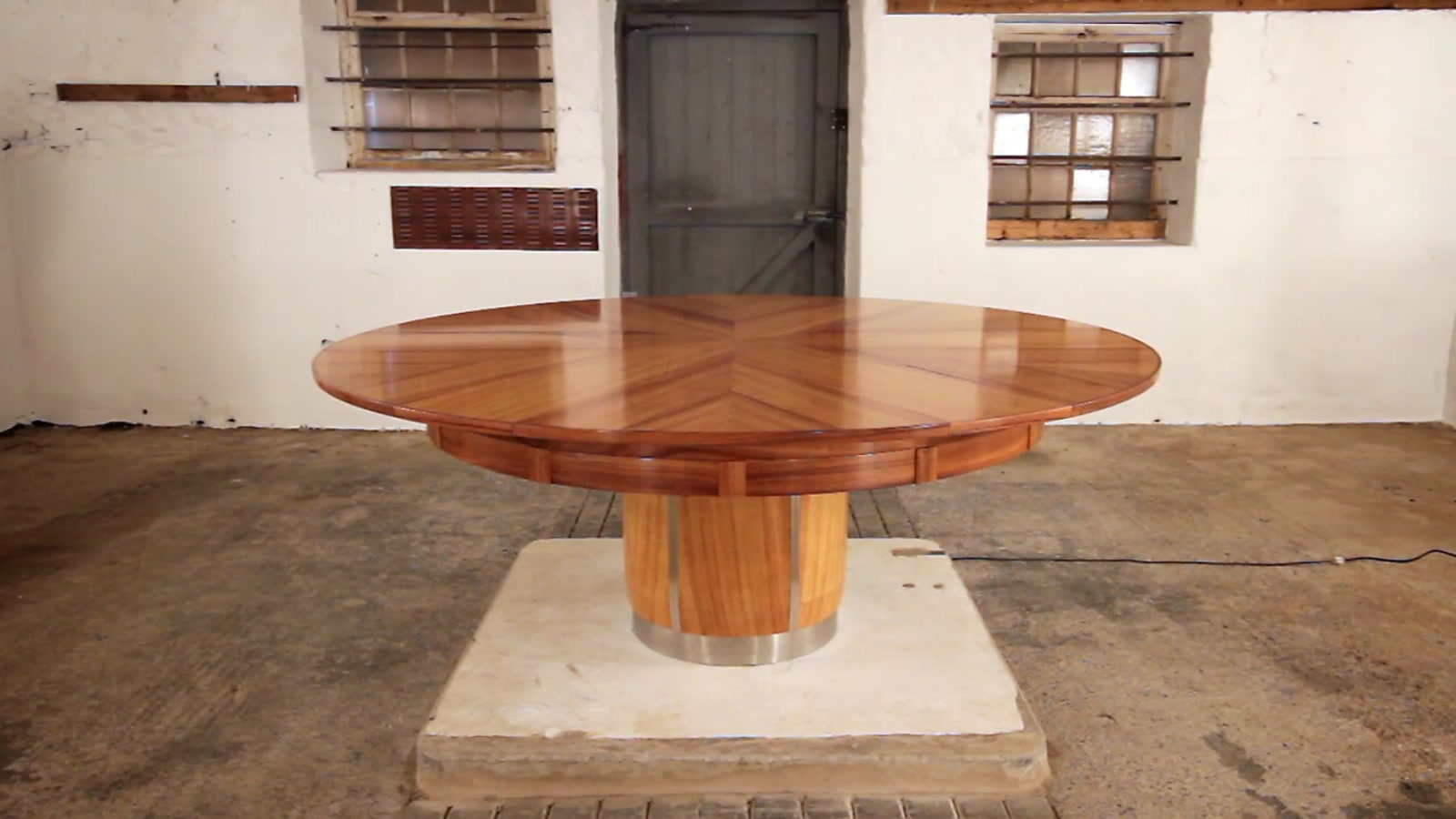
A circular wooden tabletop starts to separate along its seams. Sections move outwards, hidden leaves appear between them, and the pieces settle into a larger circle. The furniture briefly reveals the mechanism that makes its transformation possible.
The extra pieces are already inside
British maker Fletcher Burwell-Taylor builds the Capstan Table with its expansion leaves stored within the table itself. The company offers manual and electronic operation. The selected source film is labelled manual operation by the maker and shows the table expanding in a workshop.
The sequence rewards a close look. Gaps open between the main sections, additional wooden shapes rise into view, and the surface closes around them. The edge returns to a clean outline. A larger tabletop emerges from parts that were present all along.
During the change, each section follows its own path. Once the pieces settle, the grain and radial arrangement make the whole thing read as one surface again.
A design with a longer history
The company traces David Boardman Fletcher’s work on the project to 1997, taking inspiration from Robert Jupe’s nineteenth-century expanding table. Its own account describes the development of a mechanism that could keep the leaves within the furniture and maintain a circular form.
This is an archive design discovery, illustrated by the maker’s Baja Manual demonstration. The selected film is undated in the available source record. The 1997 reference dates the beginning of Fletcher’s project, rather than this particular table or film.
People & sources
Fletcher Capstan Table design: David Boardman Fletcher / Fletcher Burwell-Taylor. Original Baja Manual demonstration film: Fletcher Burwell-Taylor Ltd, linked from the maker’s website; upload date not exposed in retrieved metadata. Original English narration and editorial: HurolHaber.
Woodworking
A Ping-Pong Ball Tours Scott Weaver’s Toothpick San Francisco
Rolling Through the Bay gives ping-pong balls routes through a miniature San Francisco made from toothpicks and wood glue.
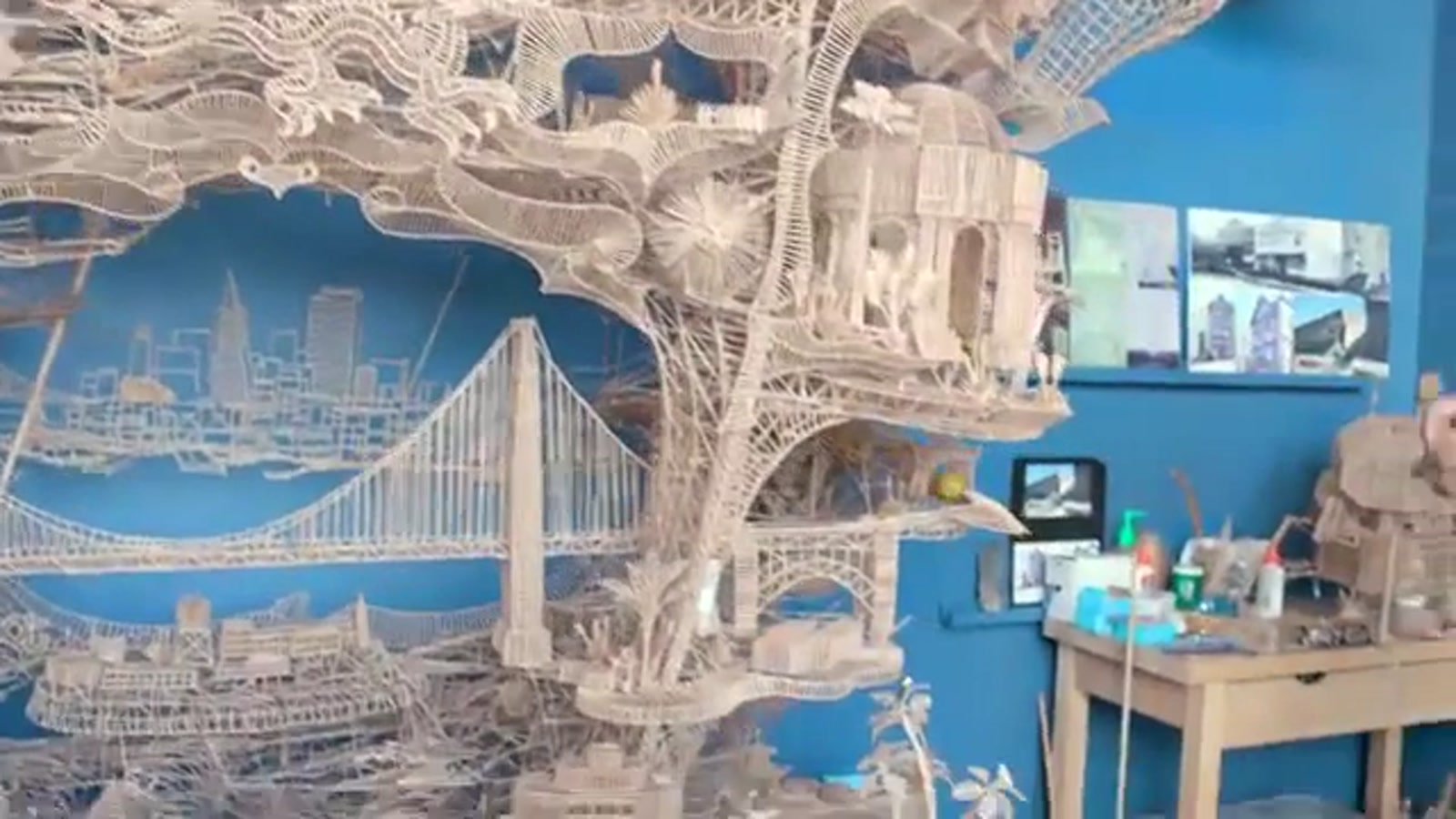
A ping-pong ball takes a tour through a city of tiny wooden lines. It passes between landmarks, disappears into the structure and returns somewhere else. Rolling Through the Bay makes the act of looking at a sculpture feel like following a journey.
The artist is Scott Weaver, and the city is San Francisco. The Exploratorium records the beginning of the project in 1974 and describes it as an ongoing work made from toothpicks and wood glue. Its ball routes turn a recognisable cityscape into something that can be explored over time.
Let the ball guide the eye
The museum’s description invites visitors to follow different tours through the model. That is a useful way to approach a work with so much detail. The ball briefly selects one line from a crowded field, giving the eye a route to follow before the surrounding architecture takes over again.
At close range, the construction remains readable as ordinary toothpicks assembled into curves, supports and small structures. From farther away, the same material gathers into a landscape of familiar San Francisco forms. The change in viewing distance is part of its appeal: both the city and the patient work of making it stay present.
A long-running work, a moving tour
Our short edit draws on the Exploratorium’s official video published on 15 May 2024. That publication date describes the source film, not the beginning or completion of Weaver’s long-running project. The museum also preserves an earlier film through its Tinkering Studio archive.
What makes the sculpture especially memorable is the relationship between the fragile-looking material and the moving route. The ball is a small guide through a much larger act of attention. Gravity gives the wooden city a temporary itinerary, while the scale of the handwork invites another look after the ball has passed.
People & sources
Rolling Through the Bay sculpture: Scott Weaver. Original museum film: Exploratorium, published 15 May 2024. Original English narration and editorial: HurolHaber.
Woodworking
Dimensions Makes Wooden Wheels Look Like a Floating Ring
David C. Roy turns overlapping wooden spokes into a changing illusion of depth, powered by a spring.
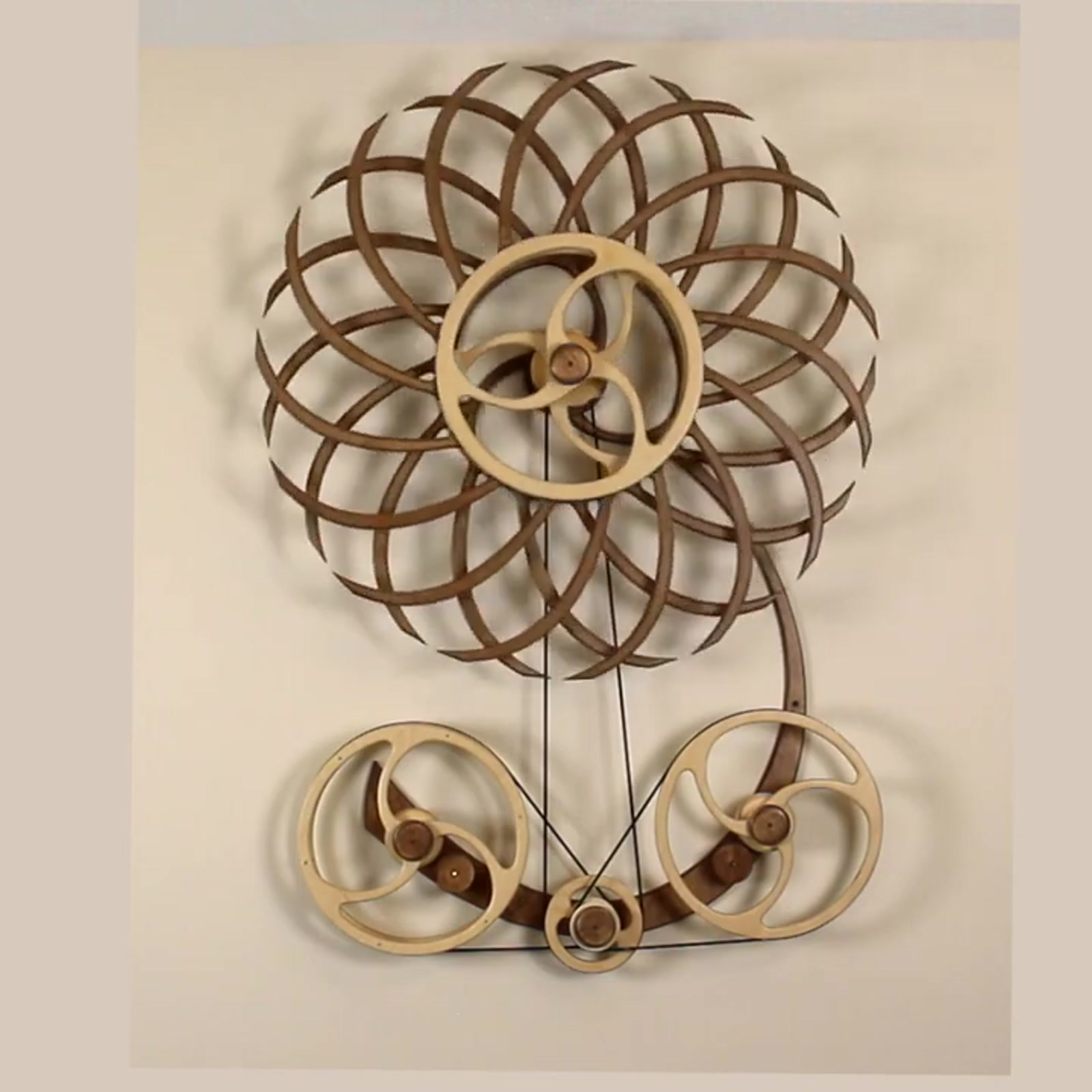
Look at the centre, then the outer edge. The wooden spokes are plainly visible, yet their changing overlap can suddenly read as a rounded ring floating in front of the wall. Dimensions lets a mechanical pattern become an optical illusion.
Depth made from overlapping motion
David C. Roy introduced Dimensions in 2015. In his project notes, he traces its visual idea to Phenomenon, a sculpture he designed in 1997. He returned to that earlier effect with revised curves, angles and spoke geometry, exploring how a collection of moving outlines could suggest a three-dimensional torus.
The demonstration makes the shift easy to follow. In a close view, each curved spoke is an ordinary physical piece. From farther away, the layered shapes become a changing whole. The wheels have not turned into a solid doughnut; the impression of depth emerges as their outlines cross.
A spring keeps the pattern going
Roy describes his kinetic sculptures as wooden machines powered by the controlled release of energy from a spring. For Dimensions, he lists an approximate running time of 40 hours from one winding. That figure is the artist’s specification, rather than a duration independently measured for this article.
The official film, published in September 2015, moves between details of the wheels and a view of the complete wall sculpture. Keeping both views matters: the close-up reveals the physical parts, while the wider shot lets the visual effect assemble itself. This is an archive discovery worth watching at its own pace.
People & sources
Dimensions kinetic sculpture and original demonstration film: David C. Roy / Wood That Works, 2015. Original English narration and editorial: HurolHaber.
Woodworking
Colibri Turns a Hand Crank into a Hummingbird’s Flight
Derek Hugger links wooden mechanisms into a remarkably expressive study of a hummingbird in motion.
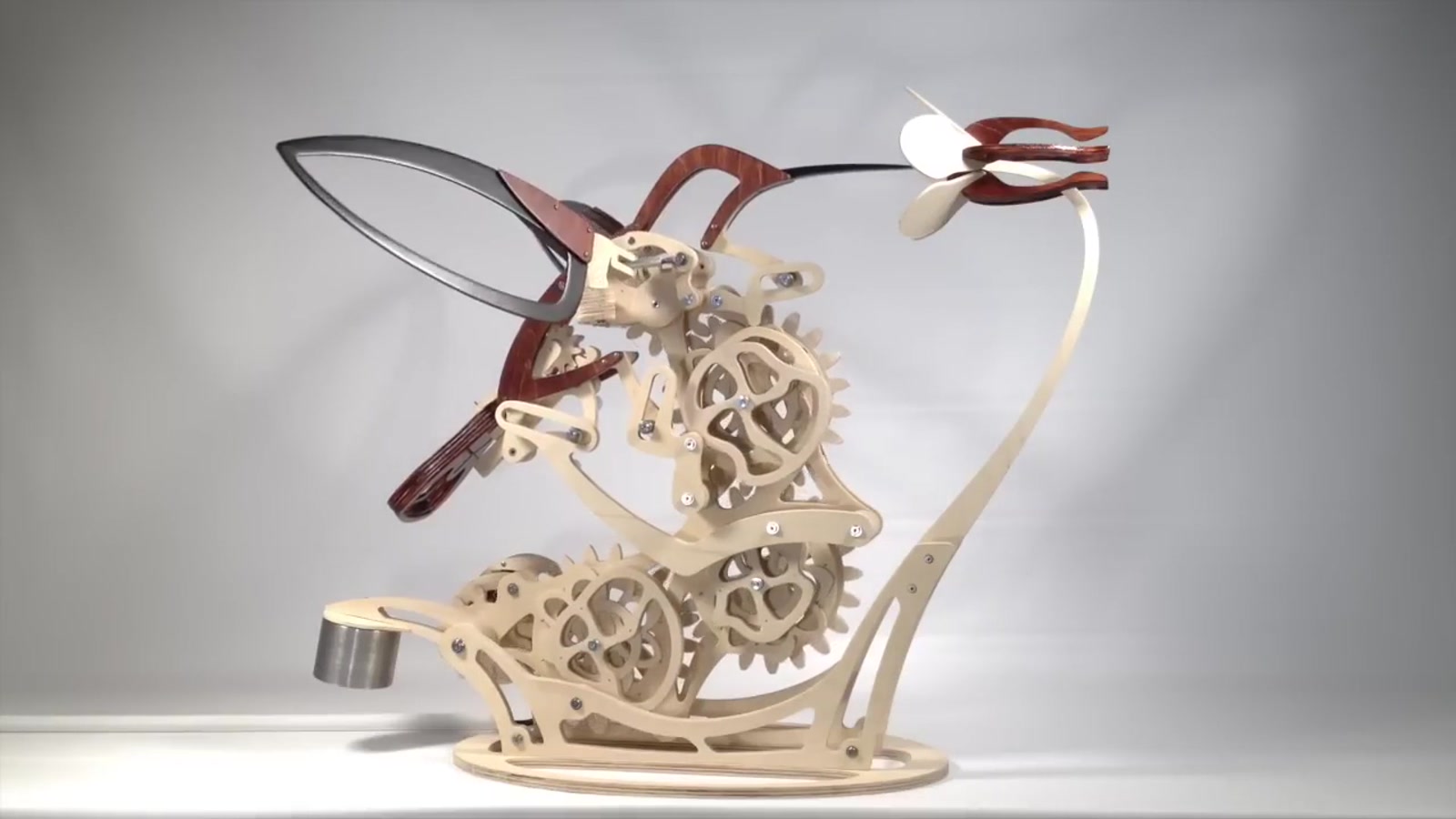
Start with the crank, then follow the movement upward. A wooden wing rises, a tail fans outward, and separate mechanical actions begin to read as a single creature. Colibri makes its workings part of the pleasure.
The rhythm is the subject
Derek Hugger describes Colibri as a kinetic sculpture that simulates a hummingbird in flight. Cams and linkages coordinate the wings, tail and other articulations. The mechanisms are connected so that turning one crank carries the sculpture through its range of movement.
A close view reveals individual parts doing precise jobs. Pull back and those jobs disappear into a recognisable gesture. That change of scale is what makes the sculpture so rewarding to watch: you can understand the mechanism and still enjoy the illusion.
A maker’s archive worth revisiting
The creator’s project page identifies the original design as hand powered and provides its specifications and woodworking-plan information. We are revisiting the demonstration as a design discovery, without assigning an undocumented creation date or treating the plans as a finished product offer.
People & sources
Colibri design and original demonstration imagery: Derek Hugger. Original English narration and editorial: HurolHaber.
Woodworking
A Wooden Cabinet That Opens into a Wave
Sebastian Errazuriz turns the simple act of opening a cabinet into an unfolding performance.
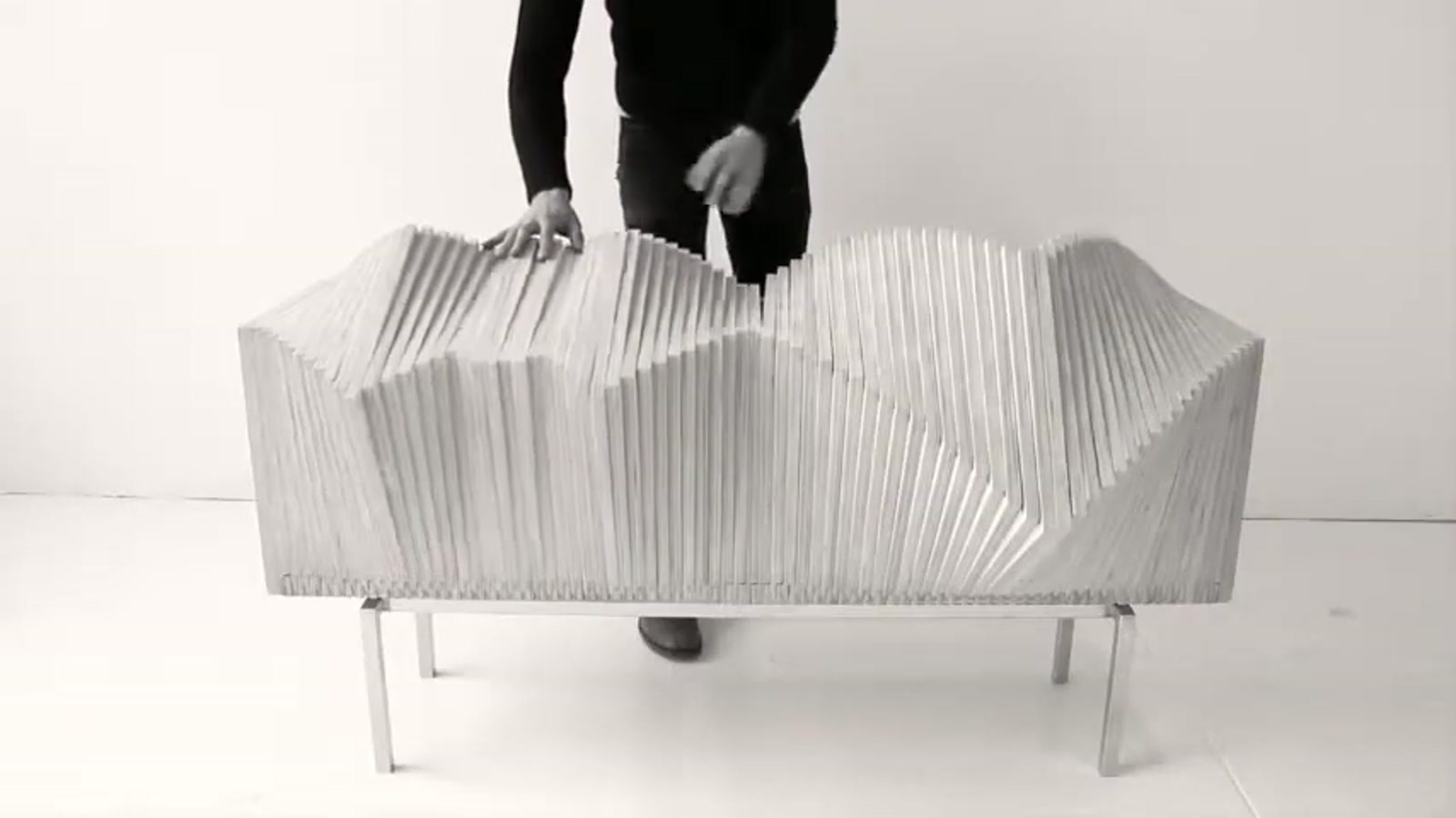
The closed object looks reassuringly solid. Then its outer line starts to separate into slender pieces, and the cabinet opens into something closer to a wave than a door.
One surface, many moving parts
Sebastian Errazuriz’s Wave Cabinet, dated 2014 in its gallery record, makes the opening mechanism the most memorable part of the object. A sequence of narrow slats lets the outer surface expand and change its profile.
The transformation is especially satisfying because the material remains easy to read. These are pieces of wood, yet their coordinated movement makes the surface feel unusually flexible.
Watch the gesture, then the whole
A close view shows the individual elements separating. A wider view makes clear what that action does to the cabinet’s silhouette. Both are useful: one explains the construction, while the other lets the choreography unfold.
The studio film was published in 2015, a separate date from the work’s 2014 design. This article revisits the documented piece; it does not imply that a new retail product has just launched.
People & sources
Design: Sebastian Errazuriz, Wave Cabinet (2014). Video: Sebastian Errazuriz; original studio film published in 2015. Original English narration and editorial: HurolHaber.

Flow Wall Desk Turns a Wooden Wall Panel into a Place to Work

BMW’s Vision Next 100 Made the Bodywork Move with the Wheels

Reuben Margolin built two raindrops from wood, pulleys and a mile of cable

Daniel Wurtzel makes a fountain that carries fabric through the air

In SCHiM, the safest route is the shadow of something moving
Flow Wall Desk Turns a Wooden Wall Panel into a Place to Work
BMW’s Vision Next 100 Made the Bodywork Move with the Wheels
Reuben Margolin built two raindrops from wood, pulleys and a mile of cable
Daniel Wurtzel makes a fountain that carries fabric through the air
In SCHiM, the safest route is the shadow of something moving




-

 Cars6 days ago
Tesla’s New FSD View Turns the Road into a Live 3D Interface
-
 Art1 week ago
John Edmark’s Spinning Sculptures Seem to Bloom
-

 Cars1 week ago
Singer’s Carrera Coupe Hides a Pair of Pop-Up Lights in Its Hood
-

 Design1 week ago
A Mechanical Garden Blooms Above the Palazzo Lobby
-

 Art1 week ago
Felix Semper’s Paper Sculptures Stretch Like Accordions
-
 Cars4 days ago
Porsche’s Electric Boxster Puts the Battery Where the Engine Used to Be
-

 Cars1 week ago
Ora Ïto Gives the Renault 17 a New Shape for an Electric Show Car
-
 Woodworking1 week ago
HygroShape Lets Flat-Packed Wood Find Its Furniture Form